Nature Comment Calls for Closing Legal Loopholes in $2.5 Billion Global Reptile and Amphibian Pet Trade
Global pet trade threatens wildlife in source countries and can spread pathogens and invasive species around the world
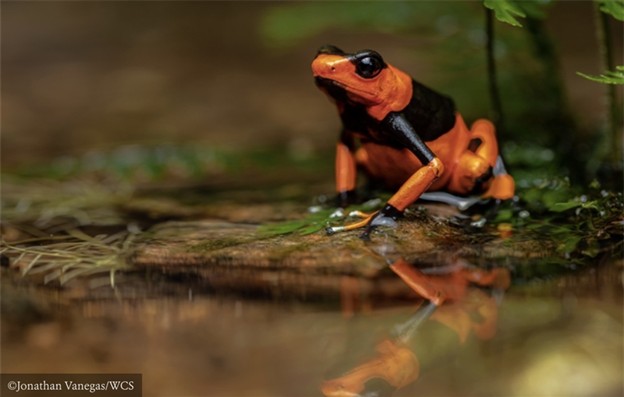
[Above photo: Endemic to Colombia, Lehmann’s poison frog (Oophaga lehmanni) is rated as Critically Endangered on the Red List of threatened species maintained by the International Union for Conservation of Nature (IUCN). The frog is included on the CITES Appendix II list due to the unsustainable tradeof this species. Photo credit: ©️Jonathan Vanegas/WCS.]
WCS contributed expertise on international wildlife policy, conservation, and health risks to a recent article in Nature that argues that governments need to close legal loopholes in the global reptile and amphibian pet trade. The authors point out that:
- The trade is large and often involves wild animals: The reptile trade is estimated at $2.5 billion, and more than half of traded reptiles and about 40% of traded amphibians are taken from the wild.
- Current laws have major gaps: Regulations often act only after a species is shown to be threatened. Differences between countries can also allow illegally or unsustainably collected animals to enter legal markets elsewhere.
- Wild populations are at risk: The authors point to species such as Madagascar's critically endangered ploughshare tortoise, which is heavily threatened by poaching for the pet trade.
- There are health and ecological risks: Traded animals can spread pathogens and become invasive. Examples include salamander chytrid fungus spreading through the pet trade in Europe and Burmese pythons contributing to ecological pressures in the United States.
- Reptiles and amphibians receive limited protection: CITES covers only about 9.5% of reptile species and 4.2% of amphibian species, leaving many species outside international trade controls.
- The authors propose stronger rules: They recommend that importing countries reject animals obtained in violation of source-country laws, expand enforcement, and consider “positive lists” that allow trade only in species demonstrated to be legal, sustainable, low-risk, and suitable for captivity.
- They also call for international cooperation: The authors support a potential UN protocol focused on environmental crimes and wildlife trafficking to harmonize laws and improve enforcement across borders.
Bottom line: The article argues that the current system is too reactive and fragmented, allowing legal trade to coexist with wildlife trafficking, overexploitation, disease risks, and invasive species. The authors want governments to make wildlife trade legal, sustainable, safe, and traceable before harm occurs, rather than responding after damage has been done.
Said Chris Walzer, Executive Director of Health at WCS, “The global pet trade creates pathways for pathogens to move across species, ecosystems, and continents.”
Read our news release.
Read the Comment in Nature